Showing posts with label future. Show all posts

Wednesday, September 27, 2017

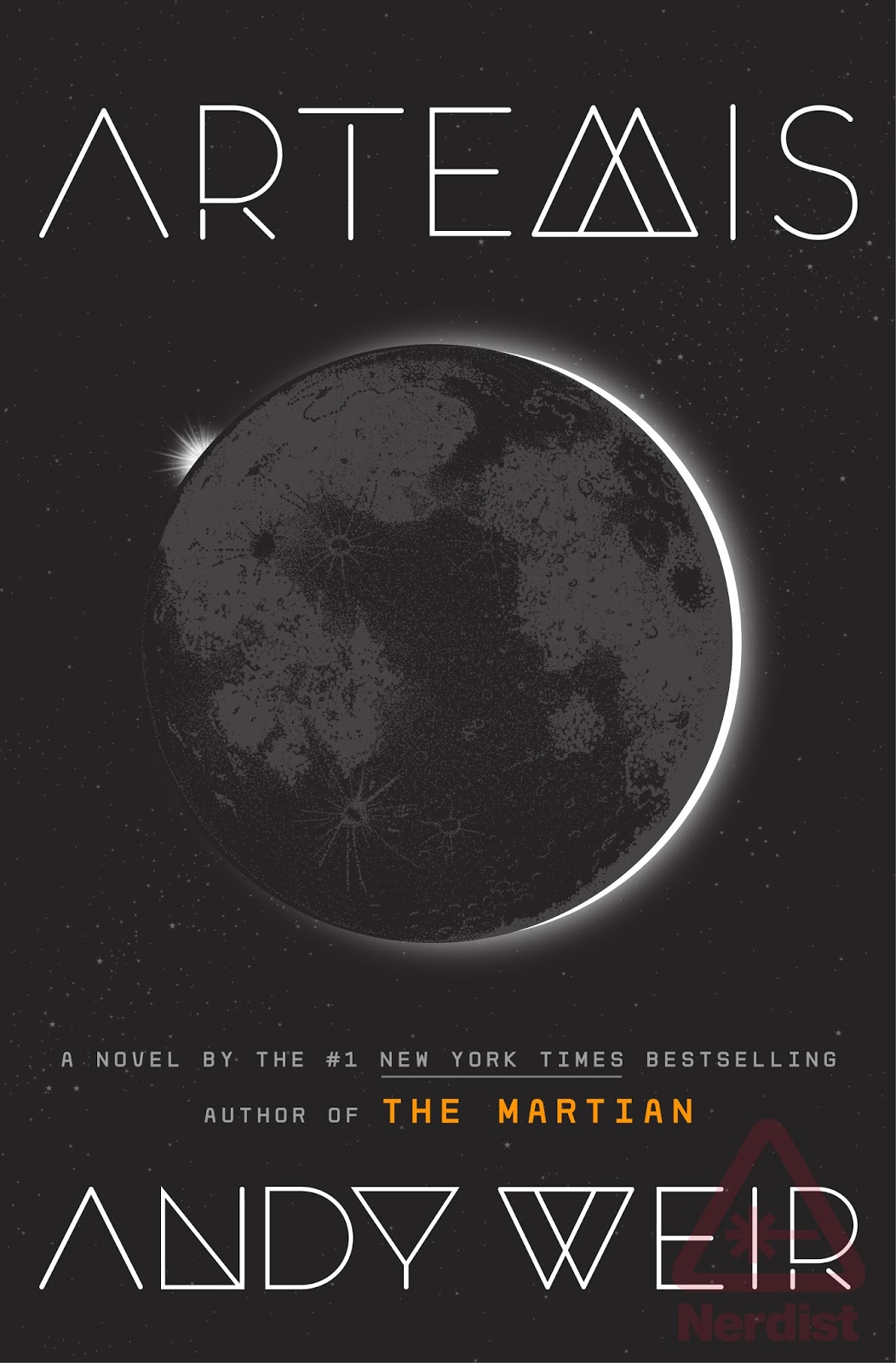
Artemis by Andy Weir

From the author: Jazz Bashara is a criminal. Well, sort of. Life on Artemis, the first and only city on the moon, is tough if you're not a rich tourist or an eccentric billionaire. So smuggling in the occasional harmless bit of contraband barely counts, right? Not when you've got debts to pay and your job as a porter barely covers the rent. Everything changes when Jazz sees the chance to commit the perfect crime, with a reward too lucrative to turn down. But pulling off the impossible is just the start of her problems, as she learns that she's stepped square into a conspiracy for control of Artemis itself—and that now, her only chance at survival lies in a gambit even riskier than the first.

Artemis is a fun romp from the author of the bestselling novel The Martian. Weir’s book is dedicated to the Apollo astronauts who flew to the moon but didn’t get to land and walk on it, a nice touch.

The world building is good. I totally believed in a city on the moon. There are a number of ambiguous characters, neither good nor bad. The science seemed real enough to this non-scientist. I liked how currency worked on the moon and also how justice for minor infractions was handled by former Canadian Mountie Rudy. I’m not a big map person but the maps at the front of the book helped me visualize the layout of Artemis.

Weir has a way with words: “If my neighborhood were wine, connoisseurs would describe it as ‘shitty, with overtones of failure and poor life decisions.’” (p. 5 of the advance reader copy)

Although I’m sure I didn’t get them all, I enjoyed the references to pop culture (e.g., "Don't get me wrong, this wasn't the farthest I'd been from the Shire or anything....But this was the farthest I'd ever been from safety." (p. 102 of the ARC).

Artemis is not a perfect book. I kept forgetting the narrator was a woman; I don’t think Weir quite nailed a female inner voice. Although I applaud his attempt to add diversity to science fiction, Jazz also didn’t seem credibly Saudi Arabian. She acted and talked like a snarky American. (Although, who knows, maybe we’ll all think and talk like that in the future when we have a city on the moon.)

Jazz is on the run at one point and dresses up like a prostitute, which seemed like a clichéd choice. Also, there is romantic/sexual tension with a number of different men, and yet she is hung up on the gay ex-boyfriend who left her for another man.

The book was slow starting as Weir did his world building but once the action started it really drew me in. The biggest issue for me was probably the amount of science. I totally believed that scientist Mark Watney knew all the stuff he knew in The Martian, but Jazz is a porter and smuggler. Although several characters comment on how she has so much potential and could be doing more with her life, I had a hard time believing she understood all the complicated science that comes in to play by the end.

So, I can’t say Artemis is as good as The Martian, but it’s an enjoyable science fiction read if you think you’d enjoy a story about a slightly implausible adventure that contains a lot of detailed factual information about staying alive in a city on the moon.

I read an advance reader copy of Artemis. It is scheduled to be published in mid-November. It will be available at the Galesburg Public Library in print, as an audiobook, and as an ebook. 

Tuesday, July 25, 2017

From the publisher: Earth, 2144. Jack is an anti-patent scientist turned drug pirate, traversing the world in a submarine as a pharmaceutical Robin Hood, fabricating cheap scrips for poor people who can’t otherwise afford them. But her latest drug hack has left a trail of lethal overdoses as people become addicted to their work, doing repetitive tasks until they become unsafe or insane. Hot on her trail, an unlikely pair: Eliasz, a brooding military agent, and his robotic partner, Paladin. As they race to stop information about the sinister origins of Jack’s drug from getting out, they begin to form an uncommonly close bond that neither of them fully understand. And underlying it all is one fundamental question: Is freedom possible in a culture where everything, even people, can be owned?
One of the most hyped upcoming releases in science fiction is Autonomous by Annalee Newitz. It is well written and kept me reading. It is, however, extremely bleak. The way the author deals with the issue of autonomy for both humans and robots is thought-provoking, as are the plot threads about health care in the future. While I had a hard time liking any of the characters, they were memorable.

This debut novel from the founding editor of the science fiction site io9 reminded me of A Closed and Common Orbit by Becky Chambers, the TV series Andromeda, and most of all the movie Blade Runner. If you like bleak space operas about a fallen Earth, this book may be for you.

I read an advance reader copy of Autonomous. It is scheduled to be published in late September 2017. It will be available at the Galesburg Public Library as a print book and as an ebook.

Friday, March 10, 2017

Defy the Stars by Claudia Gray

From the publisher: 

She's a soldier. Noemi Vidal is 17 and sworn to protect her planet, Genesis. She’s willing to risk anything - including her own life. To their enemies on Earth, she’s a rebel. He's a machine. Abandoned for years, utterly alone, Abel has advanced programming that’s begun to evolve. He wants only to protect his creator, and to be free. To the people of Genesis, he's an abomination. 

They are enemies in an interstellar war, forced by chance to work together as they embark on a daring journey through the stars. Their efforts would end the fighting for good, but not without sacrifice. The more time they spend together, the more they're forced to question everything they’d been taught was true.

Defy the Stars had me from page 1. The plot plunges right into action, with interesting characters and world building. I’m not a huge fan of the robot (or whatever) who wants to become “real,” but the author does a good job with this particular plot device and I bought into it.

Earth is approaching collapse after years of environmental destruction. The people of Earth have created “gates” that allow them to visit other solar systems, and they have chosen four planets as replacements for Earth. However, the people still living on Earth have learned nothing about good stewardship. The settlers on the planet Genesis have taken the mistakes made on Earth to heart and are trying to keep their planet healthy. They are fighting to keep the people of Earth from ruining Genesis as well.

Noemi is a Genesis soldier. She has volunteered to go on a suicide mission with other volunteers. I would have preferred that Noemi be a little older – maybe 21 or 22 rather than 17 - but this book is aimed at young adults and so she is a teenager.

Noemi and Abel, the “mech” (aka robot) that she finds on an abandoned Earth ship, are both strong but flawed. I liked them both and enjoyed the alternating points of view. Noemi and Abel embark on a mission Noemi hopes will end the war between Genesis and Earth. This takes them to each of the other planets and to Earth. The best part of the book by far for me was the descriptions of the four colonized planets, all very different and with very different inhabitants. Some of the people they meet get caught up in their plans and have their own moments to shine. (Oddly, one character is mentioned multiple times throughout the book but never actually appears. Perhaps he will appear in the sequel.)

Let’s face it, the plot is not particularly original, but I enjoyed the ride all the same. There is a fair amount about faith and God, which surprised me, but I didn’t find it heavy handed. I look forward to reading the sequel some day.

Defy the Stars will appeal to fans of the Starbound series by Amie Kaufman and Meagan Spooner. I read an advance reader copy of Defy the Stars. It is scheduled to be published in April 2017 and will be available at the Galesburg Public Library. 

Tuesday, August 2, 2016

Infomocracy by Malka Older

Wow, this is hard book to classify. I found it hard to get into at first - really, really hard. It's set in a near-distant future where nations no longer exist but governments do. Every 10 years groups of 100,000 people choose which government they want to live under.

Many of the governments have formed from corporations, like Coca-Cola and Philip Morris. Others are remnants of former nation states; Liberty it seems pretty clear has sprung from the United States. There is also a global internet organization called Information that is like Facebook and Google etc. many times squared.

I had a hard time getting into Infomocracy because there are so many characters, and many had names I am unused to so I wasn't immediately able to picture even whether they were male or female. The action also jumps all over the world, and the names of all the governments were confusing. The world building was grand and chaotic, and the important characters were compelling. (Some of the characters introduced in the beginning faded away into minor importance.) 

Once I got about 100 pages in I really enjoyed Infomocracy. I wonder if my interest was partly sparked by reading this during the U.S. political conventions. There is a lot of subterfuge, and questions about who can trust who, and think I found that more interesting because there is a U.S. presidential race going on. 

As I said, this book is hard to classify. It's hard to even say, for example, that If you liked xxx, you will enjoy InfomocracyIt is a very intelligent work, and it was refreshing to read something that really, really is not English or American-centric. I recommend it to science fiction readers willing to take a chance on something a little unusual, and to readers looking to take their mind off American politics and the election by reading a book about...politics and an election.

The Galesburg Public LIbrary has Infomocracy as a print book and as an ebook.

Monday, March 21, 2016

The Map of Bones by Francesca Haig

From the publisher: 400 hundred years in the future, the Earth has turned primitive following a nuclear fire. For some unknowable reason every person is born with a twin. One is an Alpha—physically perfect in every way; and the other an Omega—burdened with deformity, small or large. With the Council ruling an apartheid-like society, Omegas are branded and ostracized while the Alphas have gathered the world’s sparse resources for themselves. Though proclaiming their superiority, for all their effort, Alphas cannot escape one harsh fact: whenever one twin dies, so does the other. Cass is a rare Omega, one burdened with psychic foresight. While her twin gains power on the Alpha Council, she dares to dream the most dangerous dream of all: equality. For daring to envision a world in which Alphas and Omegas live side-by-side as equals, both the Council and the Resistance have her in their sights.

The Map of Bones is the second book in Francesca Haig’s Fire Sermon trilogy. The Map of Bones is easy to get into and easy to read, and it has a strong female lead. I will read the final book when it is published.

Still, The Map of Bones didn’t really pop for me. A surprise reveal toward the end seemed a bit pointless and dispassionate, as did the secret Zoe, an Alpha fighting for the Resistance, has been carrying. I have no emotional investment in the characters and I don’t sense any real commitment and feeling between them. Narrator Cass again makes some idiotic decisions, like insisting on burying an acquaintance found hanged even though her party is in an enormous hurry. The language is sometimes a little overwrought (“We trawled those dusty rooms for hours. Walls with a tracery of rust and damp. A baby’s skull the exact weight of a nightmare.” p. 275 of the digital advance reader copy)

I do recommend The Fire Sermon trilogy for those who enjoy dystopian fiction and strong female leads, and I look forward to seeing how the trilogy wraps up. I read a digital advance reader copy of The Map of Bones. It will be available at the Galesburg Public Library starting May 3 in print and as an ebook. The library also owns the first book, The Fire Sermon,  in those two formats.

Postscript: One thing that bothered me was that while the book is called The Map of Bones, the phrase “maze of bones” was used over a dozen times in the book while “map of bones” was only used once. I found this very distracting. As I read a digital advance reader copy; maybe the text will be changed before the final book is printed (although I think The Maze of Bones would have been a better title, and the cover could still have used an Alpha symbol as the A and an Omega symbol as the O).

Monday, August 24, 2015

The Scorpion Rules by Erin Bow

Hundreds of years in the future, Earth is run by an artificial intelligence. Originally human, turned into an AI in a quest for immortality, Talis took advantage of access given to him by people at the UN and forced the people of Earth to stop fighting wars. First, he blew up cities to get their attention. Then he took the children of all the leaders – the Children of Peace – to hold hostage against their good behavior. If there is war, the children of the leaders die.

Greta, the narrator of Erin Bow’s book The Scorpion Rules, is one of those children. Canada is now the Pan Polar Confederacy, and she is the daughter of their Queen. If the Children make it to the age of 18, they are sent home and new hostages are taken. If their countries go to war, the Children disappear to some unspeakable end.

We see Greta and the other Children her age studying in their classroom and doing chores on the farm. The characters are not particularly well drawn or memorable. Greta takes great pride in maintaining calm and control. The new boy, Elian, does not. He takes pride in defiance and anger, no matter how he is punished. There is much punishment in this book, and torture. The torture is not graphic but it is extremely evocative, and I found it hard to read.

For the most part, the narrative engaged me. Despite my intense dislike of torture scenes, I did feel compelled to keep reading. I often enjoyed the author’s way with words, like in this passage: “Elian reached up and took one of my wrists, stopping the motion, looking me up and down. I’m sure he was trying for as a man looks at a woman, but it came off rather more as an engineer looks at a bridge pylon.” (p. 63 of the advance reader copy). At other times, the language was a bit overwrought ("I closed my fingers around the gun, and rose to my feet like the Lady of the Lake." (p. 173))

The ending of The Scorpion Rules surprised me, and the plot took a few turns I did not expect. There is a love triangle of sorts. Granted, it is an unusual triangle – a girl with feelings for a boy and a girl – but still, can’t we be done with love triangles? That aspect of the plot was so, so tired. Greta also develops strong feelings of some sort for Elian almost immediately – not quite insta-love, but insta-something.

Some cultural references fell flat, like a bad football joke and mentions of the Road Runner.  In his Utterances, Talis actually says, “Resistance is futile.” (p. 26). Also, some scenes were a little too reminiscent of The Hunger Games series. For example, Greta is to be tortured, with coverage sent to her mother by video. The producer, Burr, paces about checking camera angles and noting things on a clipboard. He wants the other Children nearby for reaction shots. This scene reminded me very strongly of The Hunger Games (as did the repeated use of the words “Tick Tock Clock Drop”). But I guess it is hard to write a dystopian teen novel and not be compared to The Hunger Games.

The Scorpion Rules is a first book in a series. It does not stand alone. This is a good thing if you really enjoy it and want more. The ending really left a lot of room for exploration in the next book. I would recommend The Scorpion Rules for readers of young adult literature who aren’t yet tired of dystopian works and also for questioning teens, as Greta is also questioning.

I read an advance reader copy of The Scorpion Rules. It is scheduled to be published on September 22 and will be available in the Young Adult section of the Galesburg Public Library.